REVIEW · QUEENSTOWN
Milford Sound and Big Five Glaciers Scenic Flight
Book on Viator →Operated by Air Milford · Bookable on Viator
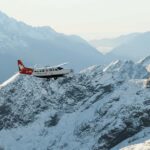
Glaciers fly by faster than you think. This 1-hour scenic flight links Queenstown with Milford Sound from the sky, and you’ll get pilot-led commentary as you pass Coronet Peak, Shotover Canyon, and a whole string of named ice fields. I really like how tightly the route is planned for big sightings in a short time, and I love the hotel pickup/drop-off that makes the day feel simple. One thing to consider: it’s weather-dependent, so cloudy conditions can change the timing of your flight.
This is a small-group style flight (max 12), so you’re not stuck in a giant herd. The “Big Five” idea comes through in the glacier views too, with options like Rob Roy, Bonar, Jura, Volta, Dart, Olivine, and Donne often showing up as you move from Mt. Aspiring toward Fiordland.
Because you’re going up and out fast, you’ll want to travel with a jacket and camera ready. If you’re hoping for a walk-on moment at Milford Sound or an onboard cruise, that’s not what this one is built for—the experience is flying the sightline overhead.
In This Review
- Key moments that make this flight worth it
- From Queenstown to Milford Sound in about an hour
- The warm-up: Coronet Peak, Shotover Canyon, and the gold-river story
- Mt. Aspiring: the Matterhorn of the South and the glacier parade
- Fiordland crossing: “glacier alley” to Milford Sound overhead
- The return path: beech forest, Lake Wakatipu, and Sutherland Falls
- What the pilot briefing and commentary change for you
- Price and value: what $343.70 buys you here
- Who should book this scenic flight (and who might skip it)
- Quick booking questions I’d ask before you go
- FAQ
- How long is the Milford Sound and Big Five Glaciers scenic flight?
- Is a landing in Milford Sound included?
- Is there a Milford Sound cruise included?
- Do I get hotel pickup and drop-off?
- What’s the maximum group size?
- What should I bring?
- What happens if the weather is poor?
- Can children join?
- Where does the tour start and end?
- Should you book this flight?
Key moments that make this flight worth it
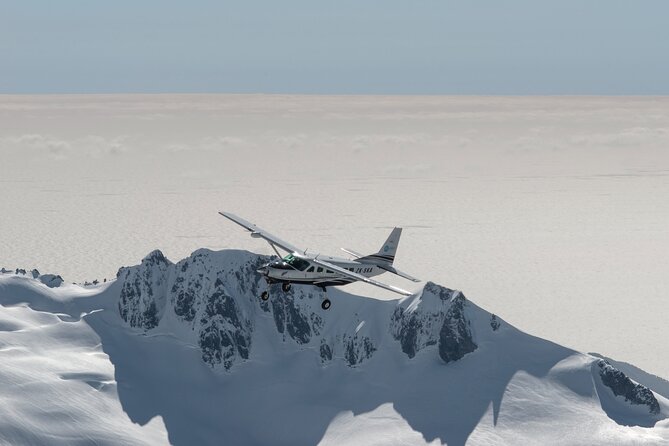
- Live pilot commentary during the flight, with a proper pre-flight briefing so you know what you’re looking at
- Shotover Canyon and Skippers Canyon views early on, including the gold-rush story tied to the river
- Mt. Aspiring’s “glacier alley” approach, including Upper Volta and the Olivine Ice Plateau area
- Milford Sound overhead with Mitre Peak rising straight out of the water (that sheer look is the point)
- Small group size (maximum 12), which usually means better sightlines and less chaos
- All-in transfers from centrally located Queenstown hotels, so you’re not coordinating rides last-minute
From Queenstown to Milford Sound in about an hour
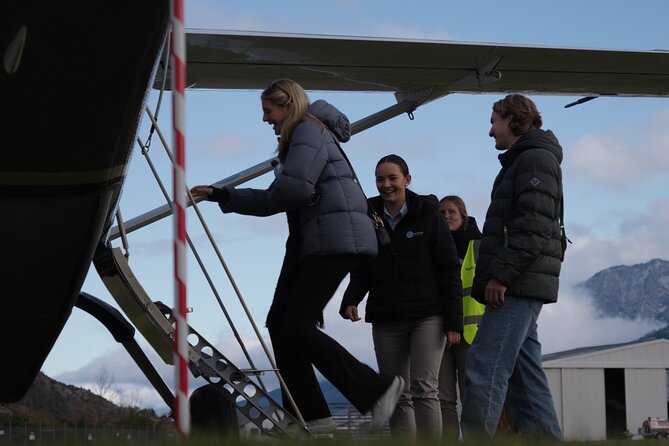
This is the kind of New Zealand trip that fits real life: you get sky time, big scenery, and you’re back out without burning a full day. The flight itself is about 1 hour, with hotel pickup and drop-off arranged from central accommodation areas.
The route is built like a “greatest hits” roller coaster. You start by heading out of Queenstown’s Wakatipu basin, then you cross the Southern Alps region and sweep into Fiordland. The timing is tight enough that you’ll feel the pacing, but not so rushed that you can’t enjoy it—this isn’t a sprint tour. It’s more like a well-rehearsed flight slideshow, with the pilot narrating what you’re seeing as you go.
And since you’re in the air, you’re getting the view that most people miss when they only look from the road: glacier shapes, ridgelines, and the way rivers and valleys cut through the mountains.
You can also read our reviews of more tours and experiences in Queenstown.


The warm-up: Coronet Peak, Shotover Canyon, and the gold-river story
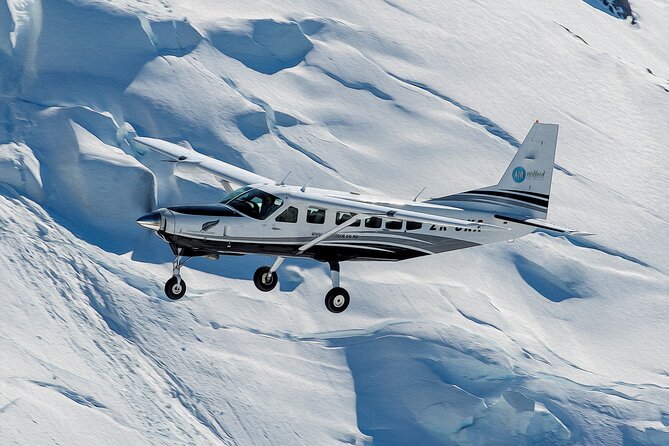
Right after takeoff, the views are all about instant orientation. You’ll spot Coronet Peak, one of New Zealand’s premier ski areas, which is a helpful landmark if you’ve seen photos of the Wakatipu region. If you’re the type who likes to match what you see in the air to what you’ve been driving past on the ground, this part helps get your bearings fast.
Then comes Shotover River and Skippers Canyon. Here’s the historical detail that makes the scenery click: gold was discovered in the 1860s, and the river became the world’s second highest gold-bearing river, next to the Klondike in Alaska. That turns a scenic gorge into a story you can actually place in time.
If you’re traveling with someone who usually gets bored on “views and more views,” this is where you win them over. It’s not just geography—it’s why this terrain mattered.
Mt. Aspiring: the Matterhorn of the South and the glacier parade
Your flight pushes north into Mt. Aspiring National Park, and the scale jumps. The pilot heads you toward the larger mountains and glaciers, and you start seeing more of the “ice field system” rather than just one peak or one patch.
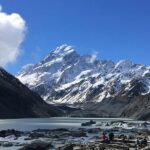
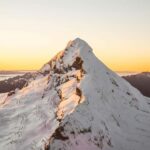
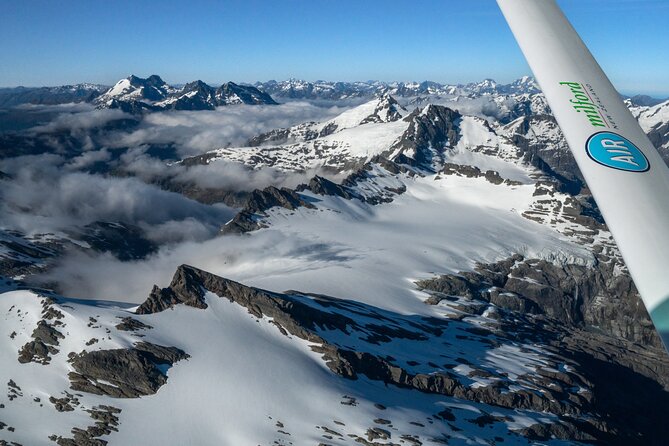
Mt. Aspiring is nicknamed the Matterhorn of the South, and it sits at about 10,000 ft / 3,030 m. The big useful point is that it links to six related glaciers, with the largest called the Upper Volta Glacier. From the air, you can often see how those glacier tongues sit like fingers descending the slopes—each one a different shape, each one a different slice of the mountain.
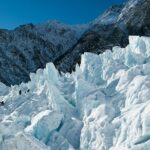
As the flight route begins to move west over the main divide of the Southern Alps, the narration shifts from “where we are” to “what the glaciers are doing.” You’ll get a glide over what’s described as glacier alley and an Olivine Ice Plateau area. That combination of names and sightlines is exactly why the commentary matters: without it, the view can blur into “snow and rock.” With it, you can pick out features and remember them.
One practical note: glacier viewing is heavily lighting-dependent. If the sun is at a bad angle, some ice texture can look flatter. Still, even on a less-than-perfect light day, glacier shapes and valleys remain readable from altitude.
Fiordland crossing: “glacier alley” to Milford Sound overhead
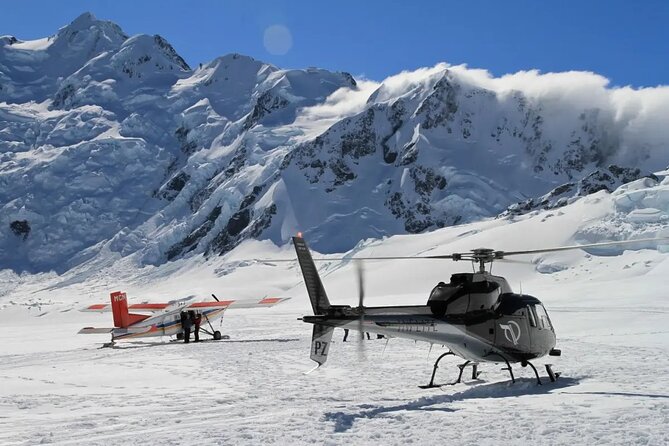
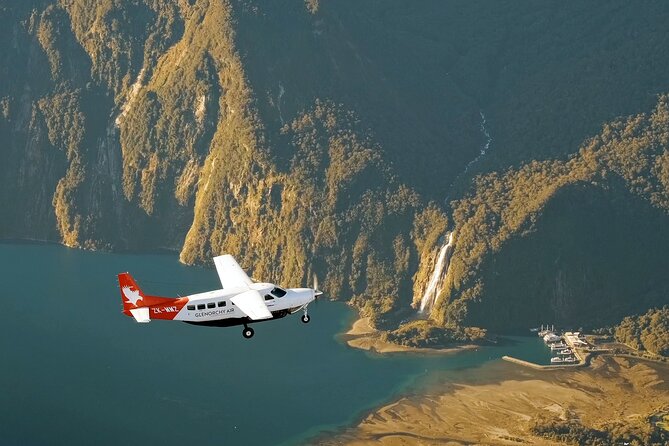
Once you leave Mt. Aspiring, you head toward Fiordland National Park. This is where the air travel stops feeling like a scenic detour and starts feeling like the only way to really appreciate the scale. The flight path moves toward Milford Sound, Fiordland’s most northerly of 14 fiords and also the one described as the most dramatic.
What makes Milford Sound special from the air is how direct the dramatic element is. The showpiece is Mitre Peak, which rises from the water to about 5,560 ft / 1,690 m—almost a mile of vertical gain. In overhead view, that vertical hit is hard to recreate from shore or road. You see the peak as a feature that dominates the whole fjord system rather than as a distant spire.
The flight then tracks beyond Milford and starts to move east toward the Southern Alps again. You’ll also get a look at Lake Te Anau, which is New Zealand’s second-largest lake, stretching out beneath the flight path.
If you’re a photographer, this is a good segment to keep your camera protected but ready. The best shots usually come when you’re prepared for sudden changes—straight after the pilot points out a landmark, the aircraft angle can shift in a way that makes the next view more dramatic.
The return path: beech forest, Lake Wakatipu, and Sutherland Falls
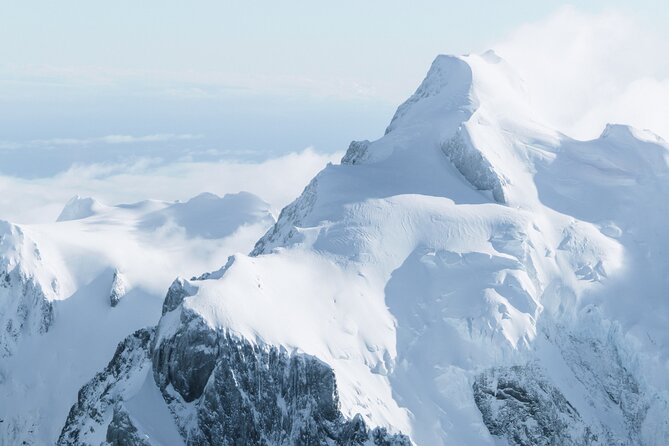
After Milford Sound overhead, the route crosses back over the divide and runs over Greenstone Valley, described as beech forest filled. From the air, forests like this read differently than alpine grasslands: you get texture and pattern rather than just color.
Then the flight emerges above Lake Wakatipu, described as New Zealand’s longest lake. It’s one of those moments where the whole trip feels connected. You came from Queenstown’s basin, and now you’re seeing the water system that gives the region its shape.
As the flight nears landing, you head along the Arthur Valley side of things. At the head of that valley, you may be able to see Sutherland Falls, listed as New Zealand’s highest waterfall. It’s described at about 1,900 ft / 58 m. Waterfalls from the air can be hit-or-miss depending on cloud cover and timing, but the fact that it’s on the route gives you a shot at a very visual ending.



What the pilot briefing and commentary change for you
This is one of those tours where the narration isn’t filler—it’s the product. The company provides a full pre-flight briefing with the pilot, then you get live commentary throughout the flight. That means you’re not just staring at clouds and guessing what you’re seeing.
I like that the commentary gives you names and context tied to the visible features. When you hear about Upper Volta Glacier, Olivine Ice Plateau, Mitre Peak, or the gold-bearing Shotover River, you’re less likely to end the flight thinking you saw “pretty mountains.” Instead, you’ll remember what was what.
Also, small details help. One recent flight experience is described as having a pilot who mixed good explanations with a sense of humor, which matters more than people think. A relaxed pilot makes the whole cabin feel calmer, and it’s easier to enjoy the view instead of treating the flight like a test.
Price and value: what $343.70 buys you here

At $343.70 per person, this isn’t a budget add-on. But it isn’t trying to be. What you’re buying is a high-impact aerial route that stacks major sights in a short window: Queenstown’s region, Mt. Aspiring glaciers, the Fiordland entry, and Milford Sound overhead—plus hotel pickup and drop-off.
Here’s how I’d judge the value for myself:
- If you only have a day or two in Queenstown and you want Milford Sound views without a long travel day, the time savings are real.
- If you’re the type who likes explanations (not just photos), live pilot commentary turns the cost into something more than a seat with a view.
- The max 12 travelers size is a hidden value lever. It often translates to more comfortable viewing and less cabin clutter.
The main trade-off is that you’re not landing at Milford Sound and there’s no cruise included. If your dream version of Milford Sound includes getting onto the water, you’d need a separate activity. This flight is about seeing the system from above, not soaking in the fiord up close.
Who should book this scenic flight (and who might skip it)
This works best for:
- People who want big scenery fast and don’t want to plan a full-day Milford Sound trip.
- Photo lovers who understand that sky views can show glacier shapes and fiord structure better than a road trip.
- First-timers to the Queenstown region who want orientation: mountains, valleys, lake shapes, and the fiord all in one outing.
You might think twice if:
- You’re specifically craving a Milford Sound boat cruise or time on the ground at the fiord. This flight is overhead only.
- Your trip timing is tight and weather delays would be a headache. The flight requires favorable weather, so build flexibility where you can.
Quick booking questions I’d ask before you go
You’ll have a better experience if you go in with the right expectations.
FAQ
How long is the Milford Sound and Big Five Glaciers scenic flight?
The experience is listed as approximately 1 hour.
Is a landing in Milford Sound included?
No. The tour does not include landing in Milford Sound.
Is there a Milford Sound cruise included?
No. The tour does not include a cruise of Milford Sound.
Do I get hotel pickup and drop-off?
Yes. The tour includes hotel pickup and drop-off from centrally located hotels.
What’s the maximum group size?
The flight has a maximum of 12 travelers.
What should I bring?
Bring a jacket and your camera.
What happens if the weather is poor?
If the experience is cancelled due to poor weather, you’ll be offered an alternative date/time or a full refund.
Can children join?
Yes, but children must be accompanied by an adult.
Where does the tour start and end?
It starts at 3 Tex Smith Lane, Frankton, Queenstown 9300, and the activity ends back at the same meeting point.
Should you book this flight?
If you want the best odds of seeing Milford Sound’s drama and glacier scenery in a short, organized outing, this is a strong pick. The combination of live pilot commentary, small group size, and hotel pickup/drop-off makes it feel efficient without feeling rushed.
I’d book it if your goal is aerial views—Mitre Peak from above, glacier shapes on the Mt. Aspiring route, and the fiord terrain that looks different than anything you’d see from the ground. I’d skip it if your dream Milford Sound day is all about getting on the water or stepping onto the fiord itself.